 Main Site
  Admissions
  Apply Online
  Help
Help  parkstreet@apeejayschool.com
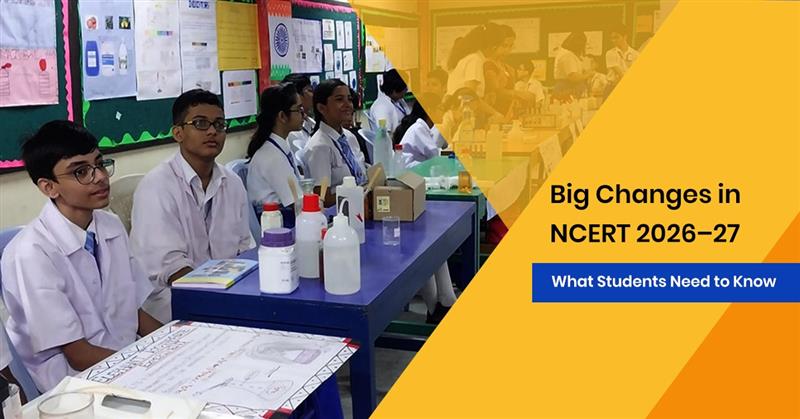
Big Changes in NCERT 2026–27: What Students Need to Know
There has been a major change brought in by CBSE board from primary level to High school education system. Major changes are implemented in the NCERT new syllabus 2026-27 to promote holistic development of students for building a better future generation. This blog will provide a detailed guide on the key changes and its benefits of the new NCERT syllabus changes.
What Are the Key Changes of NCERT New Syllabus 2026-27?
1. Structural overhaul in Class 9
NCERT syllabus changes in approach and structure. The structure for Class 9 has been redesigned completely. Subjects now focus more on understanding rather than memorization.
2. Implementation of 3-language rule
The updated NCERT new syllabus 2026-27 strictly follows the three-language policy. Students learn regional, national and international languages. This enhances communication skills.
3. Flexible subject choices in Class 11
Students can now choose subjects across streams. Science students can take arts or commerce subjects. This flexibility supports personal interests. It also reduces academic pressure significantly.The updated NCERT new textbooks 2026-27 support these modern methods.
4. Two-level assessment for Maths and Science
Mathematics and Science now have two difficulty levels in NCERT new syllabus 2026-27. Students can choose based on their learning capacity. This ensures fair evaluation. It also reduces exam anxiety among students.
5. Introduction of AI from Class 3
Artificial Intelligence is introduced at an early stage. Students learn basic coding and logical thinking. This builds future-ready skills. It also prepares them for a digital world.
FAQ. Will vocational subjects be compulsory now?
Yes, students must choose one vocational subject as per the NCERT new syllabus 2026-27. This ensures early skill development. It improves employability and practical knowledge. It also helps students explore career options beyond traditional academic paths.
6. Increased labs, projects and case studies
Learning now includes more hands-on activities. Schools will focus on experiments and real-life case studies. This improves analytical thinking. It also makes learning more engaging.
7. Competency-based evaluation system
Exams now test application of knowledge. Questions focus on understanding and problem-solving. This aligns with modern education trends. It also ensures meaningful learning outcomes. Updated NCERT new textbooks 2026-27 match the updated syllabus perfectly.
8. 33% passing rule
The passing criteria remains 33%, which includes passing in the board exam and also getting a 33% passing score in the internal assessments in school. This ensures a balanced assessment.
FAQ. How does the new syllabus reduce student stress?
The syllabus offers flexible subject choices. It introduces two-level exams for key subjects. It also reduces unnecessary content load. These changes help students learn at their own pace comfortably.
FAQ. Are NCERT textbooks changing in 2026-27?
Yes, NCERT new textbooks 2026-27 are introduced. They align with updated syllabus changes. Content is simplified and relevant. These books improve conceptual understanding and make learning more engaging for students across all classes.
How Will NCERT New Syllabus 2026-27 Benefit Students?
The updated system brings multiple benefits of new syllabus for students.
- It reduces academic stress through flexible learning options.
- This promotes creativity, critical thinking and problem-solving skills.
- It prepares students for future careers effectively.
- NCERT syllabus changes ensure equal learning opportunities for all students.
- Practical learning methods make studies more interesting.
FAQ. What is the main aim of NCERT new syllabus 2026-27?
The main aim is holistic student development. It focuses on skills, critical thinking and practical learning. It reduces rote memorization. Apeejay School prepares students for future careers .
Conclusion
The NCERT new syllabus 2026-27 marks a transformative step in education. It focuses on skills, flexibility and holistic development. Apeejay School always believes in holistic development thus they have already adapted and prepared for this new change in CBSE. Explore these updates today and prepare for a smarter learning future for your child at Apeejay School. Join in Today!
Recent Posts
- Common Mistakes Students Make Before Exams
- 🔬 Celebrating Curiosity, Creativity & Innovation! 🌟 MIND MATRIX 2.0
- 🌱 Ek Pedh Maa Ke Naam 🌱
- 🇮🇳 Har Ghar Tiranga Campaign 2026 🇮🇳 Independence Day 2026 Celebration
- SAT Workshop for students of Classes XI & XII
- 🔬⚙️💡Welcoming the STEM Student Council 2026–27! 🔬⚙️💡